














Newest filament in our offer
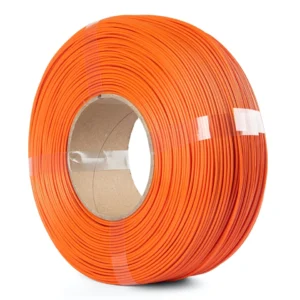
Spectrum LW-PLA UltraFoam
UltraFoam PLA with active foaming technology
Meet LW-PLA UltraFoam, our revolutionary PLA filament
that uses advanced foaming agents to expand its volume
up to three times during printing — yielding parts that
weigh as little as 30 % of a standard PLA print, without
sacrificing strength or surface quality.
Engineered for applications where every gram matters, UltraFoam is your go to for
RC models, drone frames, structural prototypes and more.


The filament is based on the proven Spectrum Premium PLA and enhanced with ingredients that allow for controlled volume expansion during printing. The foaming process is activated at around 220°C, with the maximum effect achieved in the 240°C–250°C range. When printing below 220°C, the material behaves like standard Premium PLA, offering great flexibility in choosing print settings.
In the full foaming phase filament expands more than 3x, achieving an extremely low density of around 0.40 g/cm³. LW-PLA UltraFoam provides significant flexibility in flow adjustment, enabling up to a 70% reduction. Foaming level and speed can be controlled via temperature, allowing the density to be adapted to specific parts. The foaming capability also helps to speed up 3D printing by using thicker layers or single, solid outlines. With LW-PLA UltraFoam, you can achieve prints weighing just about 30% of those made with standard PLA – over 3x lighter while retaining durability and aesthetics.
Highlight
Meet Spectrum LW-PLA UltraFoam
Spectrum LW-PLA UltraFoam is a lightweight filament designed for applications where reduced weight and material efficiency are key. Thanks to its unique foaming technology, it delivers parts that are strong yet significantly lighter, making it the perfect choice for RC models, drones, and prototyping where every gram counts.
 Easy to print
 Ultra Low Density (~0.40 g/cm³)
 Matte, rough surface with hardly visible layers
 Available as spool and refill variants
 Active Foaming Technology
 Weight reduction up to 70%
 Adjustable material density
Spot the difference
Weight Comparison


Highlight
How its working?
In order to obtain the maximum lightweight part, it is necessary to determine the expansion rate of the filament.

Print thin-wall test cube. Ensure the model has only one perimeter (vase mode). Test prints should be done in the 230°C–285°C range, preferably with 5°C intervals. Set the lowest possible fan speed (0–10%). Print speed should not exceed 15 mm/s. Significantly lower acceleration and travel speed. Dry the filament before use.

Measure the wall thickness of each test model and choose the temperature at which the wall is thickest.

Then, for the temperature determined in step 2, print calibration cubes, gradually reducing the flow value so that the wall thickness equals the nozzle diameter. Typically, the flow should be somewhere between 28-40%.
Finally, print your target model and check if the print is successful. You may need to fine-tune the flow – usually within a few percentage points of the value obtained in step 3.
Highlight
Questions & Answers
1. What is LW-PLA UltraFoam?
Spectrum LW-PLA UltraFoam is a lightweight PLA filament that uses active foaming technology to expand its volume up to 3× during printing, delivering parts as light as 30 % of standard PLA without sacrificing strength or surface quality.
2. How does the foaming process work?
Foaming activates in the hot end above ~220 °C, with maximum expansion between 240 °C and 250 °C. Micro bubbles form in the molten PLA, increasing part volume and reducing density.
3. What final density can I achieve?
Fully foamed parts reach densities as low as ~0.40 g/cm³ (versus ~1.24 g/cm³ for regular PLA). Density is adjustable via nozzle temperature and extrusion flow.
4. Do I need special printer hardware?
No. Any standard FDM/FFF machine can print UltraFoam. For best foaming consistency, an enclosed chamber helps stabilize nozzle temperature.
5. What flow rates work best?
Start at 100 % flow for baseline. Once you identify your foaming temperature, reduce flow to 28–40 % so that single wall test prints match your nozzle diameter.
6. How do I calibrate foaming?
Print single wall (vase mode) cubes at 5 °C intervals from 220 °C to 250 °C, 15 mm/s, fan 0–10%, measure wall thickness; choose the temperature with the thickest wall. At that temperature, adjust flow until wall thickness ≈ nozzle diameter.
7. What print speeds are recommended?
Test cubes: 10–15 mm/s for accurate foaming calibration. Final parts: 30–60 mm/s; the low weight allows thicker layers and outlines for faster builds.
8. Does moisture affect UltraFoam?
Yes—moisture inhibits proper foaming. We recommned to dry the filament at 50 °C for 6 h for the best printing experience.
9. How much more can I print per spool?
Thanks to > 3× volume expansion, a 1 kg spool of UltraFoam yields as much printed volume as approximately three spools of standard PLA.
10. Do colors change when foamed?
Yes—greater expansion can lighten the apparent shade. For consistent hue, adjust temperature or flow to moderate the foaming level.